
Labor Shortages: Improve Management Before Adding Staff
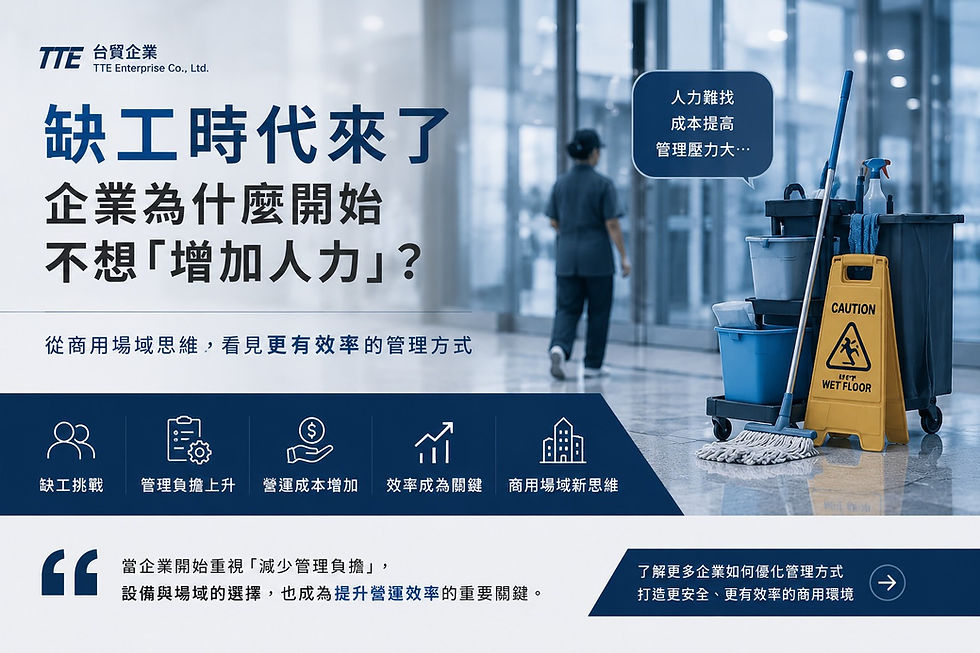
Labor Shortages: Why Businesses Are Reviewing Management Before Adding Staff
Many industries face difficulties recruiting staff.
Restaurants, cleaning providers and service businesses can all struggle to find people.
Shopping centers, office buildings and healthcare facilities can also face staffing constraints.
An interesting shift is taking place:
Some businesses no longer treat recruiting another person as the first response.
They are also asking:
Can we make the work less troublesome to manage?
The concern goes beyond the purchase price
Equipment purchasing used to focus mainly on:
Whether the price was affordable
Whether the equipment worked
Whether delivery was fast
Many businesses now pay more attention to another question:
Will this be difficult to manage afterward?
The main challenge is often not the purchase itself,
but the issues that must be addressed every day afterward.
For example:
Continual cleaning
Repeated organizing
Staff time required for maintenance
Recurring problems at the site
Over time, these demands can increase management costs.
Reducing avoidable work matters when staff are scarce
Many commercial environments are reviewing their approach.
Alongside considering additional staff,
businesses want to:
Reduce cleaning demands
Ease management pressure
Reduce consumables waste
Reduce operational risks
When recruiting becomes more difficult,
sending another person to deal with a problem is not always a sustainable response.
This helps explain the growing attention given to:
Whether equipment truly meets the needs of the site.
Why consider OEM, ODM and OBM approaches?
In the past, equipment that simply worked might have been sufficient.
Businesses increasingly seek equipment that can:
Fit the appearance of the space
Support actual circulation routes
Reduce subsequent management problems
Meet customized branding requirements
These needs can encourage interest in OEM, ODM and OBM approaches.
Businesses are recognizing that:
Useful equipment is not necessarily the equipment with the most features;
it is equipment that makes management easier.
Management efficiency is becoming a point of comparison
Price used to dominate many comparisons.
Businesses now also compare:
How efficiently they can manage operations
How well they can reduce on-site problems
How much they can ease the operational workload
Where staffing shortages persist,
reducing avoidable work can become a competitive advantage.
Staffing constraints are gradually changing how businesses purchase equipment.
The question is moving beyond whether a product works
to whether it is:
Easy to manage
Able to reduce risks
Able to ease demands on staff
Stable operations
do not always require more people;
they can also depend on more efficient management.


Comments